
Expected Threat Chain: Evaluating attack chains in scouting

Aktualisiert: 26. März

From Expected Threat xT to holistic offensive analysis Expected Threat Chain xTC
Expected Threat Chain (xTC) extends traditional Expected Threat (xT) from valuing individual passes to evaluating entire attacking sequences, including preparatory enabler passes and receiving actions that create space and increase danger.
Expected Threat (xT) has established itself as a solid and meaningful metric for measuring the offensive impact of individual actions in football. xT shows how each pass or ball carry brings possession closer to the goal and thus increases the probability of a goal, regardless of whether the action ends with a shot.
Today, we are going one step further: with Expected Threat Chain (xTC), we are expanding our view from individual passes to a holistic view of the offense. In addition to classic passing actions, we are also focusing on preparatory, connecting and receiving actions, i.e., the entire chain of events that make it possible to increase the threat of scoring in the first place.
Using analyses from various leagues and teams, we show how this expanded xT analysis is used in scouting to evaluate space gain, decision-making quality and game intelligence based on data. The new perspective makes it possible to see which players initiate, prepare and enable attacks long before the ball lands in the net.
Why shots and goals don't tell the whole story
Shots, goals and assists account for less than 1% of all game actions and are therefore of limited use for objective performance evaluation. A full 99% remain in the dark when it comes to focus. In addition, shots and goals are highly dependent on chance.
The majority of offensive impact occurs much earlier in the game. Gaining space, passing decisions, running off the ball and the structural preparation of attacks determine whether scoring opportunities are even possible. It is precisely these phases that elude traditional statistics.
In football, the few spectacular actions such as shots and goals are overrated, while the many small actions such as passes, ball control and running paths, which make chances possible in the first place, are underrated.
What Expected Threat (xT) measures
In the past, we have introduced you to the powerful Expected Threat (xT) concept.
Since goals and shots account for less than one percent of all game actions, a method is needed to evaluate the goal threat posed by passes. Expected Threat makes it possible to holistically analyze the space gained and goal threat resulting from numerous passes.
The Expected Threat concept was first introduced by Sarah Rudd in 2011 and further developed by Karun Singh in 2018 into the form most commonly used today. The idea behind it is as simple as it is effective: the probability of scoring a goal in the next few moves depends heavily on the position of the ball. The closer it is to the goal, the higher the chance of scoring – a logical approach that makes the game more tangible.
Expected Threat divides the field into zones of varying goal threat and evaluates each pass based on its starting and destination points with a corresponding value.
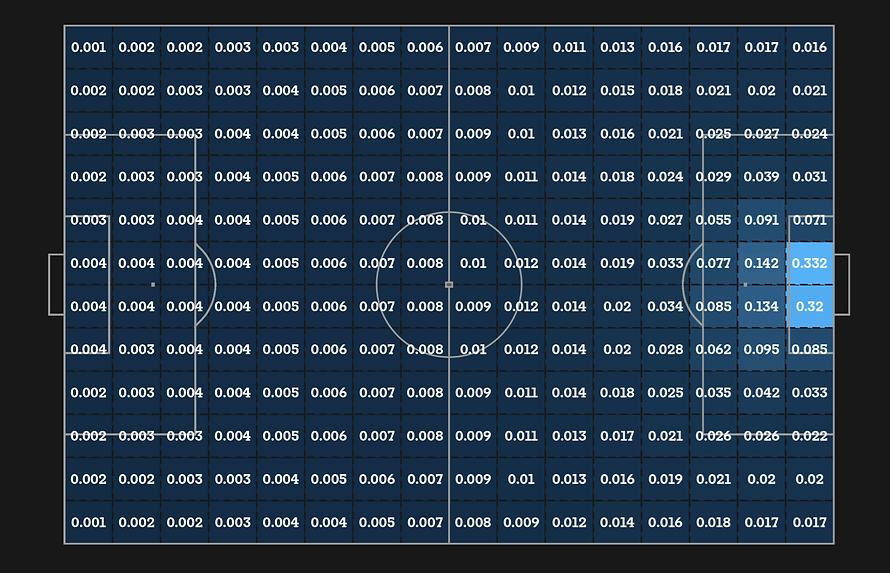
During a game, each player continuously accumulates credit in their xT account. Forward passes are given a higher value. If a player makes a lot of backward passes, their xT total decreases. xT can be used to show the contribution of all players to gaining space. xT is, so to speak, the pass account. It not only records great forward passes, but also the total amount of space gained.
In football analysis, the few notable events are often overrated, while the multitude of seemingly mundane actions are hardly noticed. This is exactly where xT comes in. With this approach, every single pass is taken into account and assigned a value—regardless of how unspectacular it may seem at first glance.
From Expected Threat to Expected Threat Chain
The best space conquerors and creative players are a thrill for spectators and fans and invaluable to every team and coach. They drive the ball toward the goal, find space where there seems to be none and recognize passing windows before they close. They play in the zones that open up new opportunities. Every centimeter counts.
The Expected Threat Chain is the logical next step toward a holistic view. Instead of evaluating individual passes, it analyzes entire attacking sequences and assigns contribution values to passing, assisting, and receiving. This reveals who initiates, stabilizes, and enables attacks, even without a direct finish or assist.
Expected Threat Chain Player impact throughout entire attacking actions
The Expected Threat Chain shows the influence of players beyond goals and assists. It evaluates not only the final pass, but also the space-creating actions that precede it, as well as the correct running and receiving. This makes it possible to measure the contribution to gaining space and creating goal-scoring opportunities throughout the entire action, highlighting those players who structure and accelerate the game long before a shot is taken.
The concept was developed by Ben Griffis. We have adapted it to our game-related preferences.
The central components of the xT Chain
xT Pass
A player's direct pass value.
Skill: Progressive and line-breaking passes.
xT Assisted
The value of the preceding pass that opens up space.
Skill: Passes that open up space, usually from defense or midfield.
xT Received
The value of the pass recipient for clever running and receptions..
Skill: Finding space, running and ball control in gaps and in depth.
xT Chain Total
The sum of all three xT values: Passing + Assisting + Receiving.
Shows the total contribution to goal threat.
If you only want to look at pure passing when scouting defenders and midfielders, you can use the sum of xT Pass and xT Assisted.
In business and in football. Focus on the process, not the result.
Expected Threat Chain Application in scouting and game analysis
The xT Chain is also particularly valuable in scouting. It enables a holistic view of passing and receiving passes and allows players to be compared objectively with one another.
In line with our playing philosophy, we only consider actions from open play and deliberately exclude crosses because we prefer flat passes into the penalty area.
xT Chain is not about discovering players like Wirtz, Salah, or De Bruyne.
They are world class and stand out even without smart metrics. Instead, the focus is on the less conspicuous players and up-and-coming talents – those who are not yet in the limelight but who become visible through their consistent contributions with xT Chain.
With Expected Threat Chain, we understand not only how a player performs, but also how strong. Whether they shape attacks with progressive passes, prepare them as enablers, or make them possible by running into space. And to what extent they contribute to increase goal threats.
Another advantage is the benchmark. This allows us to see how much players differ from each other in their individual contributions.
Sample analysis – 2022 World Cup Final Argentina vs France
Here is an initial sample analysis based on the 2022 World Cup Final:
The xT Chain values show who achieved the best scores in passing, assisting, receiving and xT Chain Total. Assisting highlights the smart playmakers who set up valuable passes, while receiving rewards ball control deep in the opponent's half.

UCL Barcelona 4-1 København

Expected Threat Chain Premier League 25-26
The xT values are p90 adjusted values. Players with at least 600 minutes of playing time after 20 rounds were taken into account.

Omari Hutchinson (22, RAMF) Nottingham Forest is one of the “quiet” winners of the 2025–26 Premier League season. Unassuming in appearance, but striking in effect. His progressive passes and clever runs between the lines consistently increase his team's expected threat. Above all, it is his outstanding and smart pre-passes that make the difference. A player who falls through the cracks when measured by conventional metrics and xT. Hutchinson looks for space and impresses with his timing, clean passing and high game intelligence. A player who makes games better without taking over. That's exactly why he's one of the big surprises of the season.
Expected Threat Chain Bundesliga 25-26
The xT values are p90 adjusted values. Players with at least 600 minutes of playing time after 15 rounds were taken into account.

At 17 years of age, Lennart Karl is one of the Bundesliga's top players in key xT metrics. In areas such as xT Received and Progression, he is performing at a level that is usually only achieved by exceptional talents. This underlines his extraordinary ability and his relevance at the highest national level.
Find out how we identified Lennart Karl with data in the U17s and how similar he is to Ousmane Dembele in the article: Discovering the Stars of Tomorrow: How Algorithms Transform Scouting
Expected Threat Chain Super League 25-26
The xT values are p90 adjusted values. Players with at least 600 minutes of playing time after 19 rounds were taken into account.

The experienced Miroslav Stevanovic (35) with a clear style. Stevanović controls the pace of the game, delivers consistent xT output in his passing and is also strong at finding space between the lines. High repeatability, clean decision-making, little variation. Exactly the type of player who gives structure to the game and makes young players better. Still in a class of his own.
Expected Threat Chain Austrian Bundesliga 25-26
The xT values are p90 adjusted values. Players with at least 600 minutes of playing time after 17 rounds were taken into account.

Already physically and structurally mature at 21 years of age. Moussa Kounfolo Yeo combines high intensity against the ball with strong progression. His xT comes less from dominance on the ball and more from timing, dynamism and intelligent runs in behind. A typical Red Bull midfielder with clear development prospects at a higher level.
Expected Threat Chain Arsenal 25-26
Of course, we can also apply xT Chain at the team level.
Here is the Arsenal analysis after 18 rounds, not adjusted for p90..

Expected Threat Chain FC Thun 25-26
xTC at team level FC Thun in the Super League 25-26 after 20 rounds (not adjusted for p90)

Conclusion: Expected Threat Chain xTC in scouting
The Expected Threat Chain is a logical further development of the xT model. By including pre-passes and ball receptions, it enables a holistic view of the player's contribution in attack chains.
Expected Threat Chain reveals how players lay the foundation for successful attacks through smart passing decisions, space-creating preliminary actions and precise running into space.
In classic event analysis, individual actions such as passes or dribbles are evaluated separately. However, this isolated evaluation neglects the fact that many plays consist of chained actions whose value often only emerges in combination. Expected Threat Chain takes this into account and looks at the entire chain of events.
This approach offers major advantages, especially in scouting. It allows players to be identified who regularly make game-changing preliminary actions and whose contribution often remains hidden in classic metrics. This is a clear step forward for data-driven scouting and team planning.
The future of data-based football analysis lies in understanding chains of space gain, not just in terms of the final shot or assist.
Expected Threat Chain Infograph

Article as AI Podcast:
More on Football Analytics
Data is transforming football in a lasting way. If you want to understand how modern football works with data, explore our content on football analytics, data-driven game analysis and data driven scouting.
Understanding the Basics
Data Analysis in Football – Learn how football analytics has evolved, which metrics are crucial, and how professional clubs use data in practice.
Data Driven Scouting
Data Scouting in Football – How data-driven scouting approaches identify talent and create sustainable competitive advantages.
Player Scouting with Similarity Algorithms – How Algorithms Transform Scouting: Identifying Tomorrow’s Stars with Data
Tactical Innovation in Football
Tactical Innovation in Football – How new ideas and data-driven approaches are changing the game, including concrete real-world examples.
Learn Analytics
Learn Football Analytics - 30+ videos and podcasts, explained in a concise, understandable, and practical way.
For Clubs and Agencies
Football Analytics Services – Data analysis, scouting, and customized solutions for better decision-making in professional football. Follow us on LinkedIn for case studies, analyses and new football analytics approaches.
Did you like the quality of our post? Then reward our hard work with your “credits” and like and share this post within your network. Thank you very much.
To make sure you don't miss any posts, you can subscribe to the blog here.
footballytics - improve the game
We support clubs and agencies with analysis and consulting services to help them use and interpret data in a targeted manner. This enables better decisions in scouting and game analysis.
www.footballytics.ch About data analytics topics in football - improve the game - change the ǝɯɐƃ
Share this post


